Have you ever noticed in all the big international athletic sporting events, such as the Olympic Games, that the events are so unrealistic – and the people who enter even more so?
The Olympic Games have a serious problem: their link to reality is extremely tenuous, at best.
To put it differently, the events in the Olympics are nowhere to be found in real life. An example: your average family man or woman is hardly likely to experience a situation in which their only chance of success is to put a shot, or successfully complete a two-and-a-half somersault and pike, whether it's a difficulty factor of 3.2 or not.
The International Olympics Commission needs to organise some events that require real-world skills to compete.

 Anchor:
Good Evening and welcome to the first day's highlights of this, the inaugural People's Olimpiks. I'm Joe Terrific, with you throughout the next ten days, bringing you all that happens – and all the changes in this exciting, new-look Olimpiks.
The first change you may have noticed, of course, is the spelling. In fact it was decided by asking you, the sporting spectators of the world, how you would spell the word 'Olimpiks'. And that's what was decided – a bit of a coup for the Germans there.
Last night, of course, was the Opening Ceremony of the People's Olimpiks, and as you can see on your screen now, it was held in the local pub, just around the corner from the Olimpik Stadium, with each participating nation shouting a round. Proceedings went very well, as you can see, with most competitors passing out by the time they reached Malaysia. The complete opening ceremony will be repeated tomorrow morning at 5.30 am here on ABC.
Field events featured strongly today, and highlight of the program was the Room-and-a-Half Scramble.
Sincere Voice Over:
 The Room-and-a-Half, a Scramble to get that last tim-tam from the biscuit barrel, replaces the 100m sprint. This event also incorporates what used to be lightweight boxing, since in today's highly competitive sporting environment, the participants invariably arrive at their objective simultaneously. The Room-and-a-Half is held in a typical suburban flat. Athletes are placed in a seated position on a couch facing in the wrong direction, that is, towards the television. The start of the event is signalled by the beginning of an advertisement. The athlete who consumes the most of the chocolate biscuit wins the event.
 Anchor:
An exciting finish to the early heats of this event, as Liberia's Franklin Miller actually reached the biscuits first, but was soon beaten into submission. In the finals of the Room-and-a-half, Gold went to Australia's Darren Philips, with a time of 7.34 seconds, and a final biscuit mass of 7.43 grams. Silver went to Great Britain's James Quigley, and bronze to Michel Durand of France.
Next on today's card was the
Blocked Room-and-a-Half >>
 Another Sincere Voice Over:
The Blocked Room-and-a-Half is another scramble event, also featuring chocolate biscuits. But in this case, competitors must deal with several closed doors, and a surplus of furniture in the direction of the kitchen. This event replaces the 100m hurdles.
 Anchor:
In a unexpected turn around, Liberia got Gold today, with Franklin Miller's outstanding time of 9.34 seconds. His excellent ability to jump the furniture no doubt contributed to his success, and he himself credits his success to his experiences dodging government troops in Monrovia during the current civil war. The Australian, Italian and Hungarian competitors, looking good at the start, all crashed into furniture and had great trouble recovering. This left the path clear for the United States' Harry Burgermeyer to walk right over the top of them and receive silver with bronze eventually going to France's Jacques Laurent.
After the spectacular lunch-time displays by the official People's Olimpiks Marching Team, it was the
Three Block Dash >>
 A Slightly-less enthusiastic Voice Over:
Replacing the 400m sprint, the Three Block Dash for the Morning Train begins with a cup of coffee. As the competitors notice the time, they must down the coffee, sprint the three blocks to the station, and pursue the now-departed train down the line. The winner is the athlete who manages to pursue the train for the greatest distance before giving up in dejection. In the five-year history of this event, nobody has successfully caught the train, probably a result of the accuracy of train timetables, or the lack of same.
 Anchor:
Another surprise turnaround. Odds-on favourite was Japan, for their experience in public transport. But it was Ghana that took out the Gold, with Obed Asomoah achieving 534.3m In an interview the Japanese coach said he believed this was due to Ghana having the worst public transport system in the world, and he concedes that Japan's usually punctual commuter trains have put them at a disadvantage in this event. Robert Jones easily took the silver for Great Britain with 498.7, but there was a battle and a half for bronze, with most African nations looking as if they were in there with a chance. Eventually it was Botswana, with Ketumile Joni scoring 483.5.
But the most exciting and close-matched event of the first day was the event best known to western nations as the "Did you hear about Martha?".
It's the
Four-by-One-Block Gossip Relay >>
 Voice Over:
Four-by-One-Block Gossip Relay begins with the referee giving a snippet of information to the first member of each team. Each team member in turn runs down the block and passes the information on to the next team member. The winning team is the team that spreads the information fastest, and points are deducted for accuracy.
 Anchor:
This event was hotly contested even before it started, with no country showing any significant advantage. There were also protests over the Chinese team, because each of them spoke a different Chinese language, and automatically gained an inaccuracy advantage.
China, along with other countries with different dialects, were eventually allowed to enter
mixed-language teams as long as they could prove that the competitors had spoken that language all their life in the country they were representing.
The race was restarted when it was found the Italian competitors had started gossiping before they were told the information. But the second start was successful, and China soon discovered that their mixed language team was actually a disadvantage, when their competitors were slowed down at each exchange, trying to make themselves understood. At the final exchange, the Chinese team had exchanged absolutely no information at all, and it was therefore impossible to judge it inaccurate.
The Italians won Gold, attributed not only to the speed at which they spoke, but also to their misleading hand signals, which managed to get them an accuracy index of 0.23 and an overall time of 68.3 seconds. The United States received silver with a time of 71.3, and the bronze going to Poland with 719. Great Britain was looking rather good up right until the final exchange but their last team member, Martha Bogingham, accidentally, warped the snippet back to what it originally was.
The Pentathlon and Decathlon events started today, and although the first day's scores haven't been released yet, it looks like we're in for some exciting action over the next five days.
Voice Over:
The People's Olimpiks Pentathlon and Decathlon are held over five days. The Pentathlon consists of nipping round the comer to get the milk, jumping the fence, jumping some stairs, throwing a round thing and eating a tim-tam. The Decathlon includes the same events, except you have to eat six tim-tams.
Final wrap-up of tonight's coverage >>
Anchor: And that's today's action in the People's Olimpiks. Later tonight, more highlights, with full coverage of the Speshal Olimpiks, which start in just under an hour. The Speshal Olimpiks for the paralysed includes the same events as the People's Olimpiks, but competitors must first down twelve pints of heavy or a bottle of scotch.
And tomorrow, our coverage includes the Once Round the Block with the Dog, replacing the 400m walk, gymnastics events such as the Kitchen Chair Lean-Back-and-Balance, Walking along the top of a brick wall exercises, Staying Upright in a Rapidly Decelerating Bus, and the ever-popular Fucking in a Deck Chair. Swimming events scheduled for later in the week include Staying Afloat, Touching the Bottom of the Pool, and Reaching the Other End of the Pool. Diving events: Jumping Off, Making a Big Splash, and Coming to the Surface Alive.
We leave you tonight with an action replay from last year's Australia Games, the Thrown Coaster Decapitation, in which Australia's Bruce Eissman won Gold. He is, of course, expected to do well in tomorrow's competition here at the People's Olimpiks.
Voice Over:
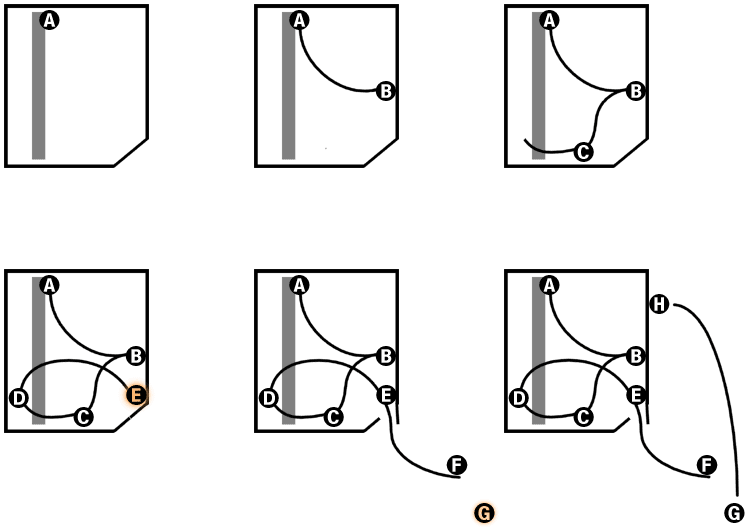
Replacing the old-fashioned discus, the Thrown Coaster Decapitation is staged in a crowded corner pub. A beer-soaked coaster is flung across the pub by a drunken athlete. Points are awarded according to the damage caused.
 Wildly Enthusiastic Commentator:
Eissmann in the blue singlet at the end of the bar (A).. he lets rip a shot that's amazing the other athletes as the sonic boom hits them. He's quickly ordering a Coopers, while the coaster continues up... it's completely destroyed the Sky Channel telly (B) the force of the explosion it helping it curve away (C).. some poof had his long hair cut off... continuing right up to the southern end of the bar (D)... and just amazing timing by Eissmann here, because the bloke behind the bar has just opened the fridge to get his Coopers... through the fridge, luckily nothing's destroyed but some Fosters and nudged through another open fridge door by a bottle of Southwark... Eissmann's well on the way to Gold here... the coaster's soaring through the door (E)... it's scared some poor drunkard half to death (F)... he's dropped his flagon... and a Volvo driver [represented here by the letter G, although we suspect another letter would be more appropriate] is too busy to cope with both driving and the car phone and avoiding the drunk... he's distracted.. he's crashed... right through the bar wall (H). And the coaster has finally stopped the cards are coming up, and yes! It's gold, gold gold for Australia, and for Bruce Eissmann, with a total damage score of $34,426.78... putting him way ahead of his nearest competitor, Wayne Newell, who managed to cut a drinker's arm in half, assessed at $23,978.24 of medical expenses.
Theme up, roll credits.